The Boston Globe Names NewFed Mortgage a Top Place to Work in 2025

December 8, 2025

Special Edition of Globe Magazine Honors the Best Employers in Massachusetts

Boston, Massachusetts, December 8th, 2025 – NewFed Mortgage Corp. (NewFed Mortgage), a family-owned lender with a 25-year legacy of delivering exceptional mortgage experiences, has once again been recognized by The Boston Globe as a Top Place to Work—earning a spot on the 2025 list and rising to #15 in the Medium-Size Companies category.

This marks the second consecutive year that NewFed Mortgage has been honored among Massachusetts’ most outstanding workplaces. The Top Places to Work awards spotlight organizations that cultivate strong culture, provide exceptional support for employees, and demonstrate values-driven leadership. Rankings are determined exclusively through confidential employee surveys.

A Workplace Defined by Integrity, Innovation, and Family

“We are incredibly proud to be named a Top Place to Work for the second year in a row,” said Rob Jewett, Chief Operating Officer of NewFed Mortgage. “Climbing the rankings to #15 is a testament to the people at NewFed—their dedication, collaboration, and commitment to serving homebuyers with excellence. Our team is the heart of our company.”

Now in its 18th year, The Boston Globe’s Top Places to Work list recognizes 175 employers across the Commonwealth. This year’s magazine features stories on what makes great managers, how DEI initiatives are evolving, and why engaged employees remain the foundation of successful organizations. Expanded digital content, including sortable rankings, is available at Globe.com/TopPlaces and through the hashtag #workboston.

“As our company continues to expand into new states and invest in advanced technology platforms, our priority remains unchanged: fostering a culture of integrity, innovation, and family,” said Hans Plum, Executive Vice President of National Strategic Sales & Growth. “Being recognized again—and moving up in the rankings—underscores the strength, resilience, and unity of our team.”

Throughout 2025, NewFed Mortgage continued to enhance its nationwide footprint, strengthen operational efficiencies, and invest in employee-focused programs designed to support professional growth and long-term success. Receiving this recognition for a second year affirms the company’s ongoing commitment to cultivating an environment where employees feel valued, supported, and inspired.

About NewFed Mortgage Corp.

NewFed Mortgage Corp. is a nationally recognized, full-service mortgage company leveraging over two and a half decades of residential retail mortgage lending to provide premier financing experiences for clients in 25+ states nationwide.

NewFed Mortgage Corp. is a Fannie Mae/Freddie Mac seller-servicer. They offer a complete line of products, including Agency Conventional, Jumbo, and Non-QM mortgages. NewFed Mortgage Corp is an approved lending institution for the VA (the U.S. Department of Veterans Affairs), USDA (U.S. Department of Agriculture), FHA (Federal Housing Administration), and various state housing programs. They provide access to different innovative portfolio products, ranging from first-time homebuyer programs with little or “zero” down, “pick your term” traditional fixed-rate products, ARM programs, USDA Renovations, VA Renovations, 203k, or Homestyle renovation loans. They also provide access to custom-fit portfolio programs tailored to meet clients’ specific needs.

Committed to local lending, the NewFed Mortgage Corp team loves what they do and the impact they leave even more. They’re your neighbors, after all. With a family-style approach to fully understanding clients’ needs, working with this team will never feel transactional. The company takes an all-in team approach right from the beginning of the process, providing personalized service and open communication from loan processing through loan closing. Their tagline, “Mortgages for every stage of your life™,” is their mission. This mission is achieved through establishing deep connections with clients so that they turn to NewFed Mortgage Corp as a reliable financial partner for years to come.

Learn more about NewFed Mortgage Corp at www.newfed.com.

About Boston Globe Media

Boston Globe Media Partners, LLC is a locally owned, award-winning media company serving Boston and New England. The cornerstone of the brand is The Boston Globe, a 27-time Pulitzer Prize-winning news source and one of the most successful metro news organizations in the United States. The Globe is headquartered in Boston with regional bureaus in Washington, D.C., Rhode Island, and New Hampshire. The Globe has one of the highest daily print circulations among metro newspapers and more than 245,000 digital subscribers. As part of Boston Globe Media’s growing portfolio of brands, the Globe hosts events that connect community members to its journalism and provides a range of digital and home-delivered advertising solutions that reach more consumers than any other New England media brand. Boston Globe Media’s properties include The Boston Globe, Globe.com, Boston.com, STAT, The B-Side, Globe Publishing Services, Globe Events, Studio/B, and the weekday news program Boston Globe Today on NESN and online.

Press Contact

NewFed Mortgage Press Contact Information:

Emmi Baker, VP Marketing Director, NewFed Mortgage Corp

Email: esauls@newfed.com
What a 50-Year Mortgage Could Mean for Homebuyers

November 11, 2025

What a 50-Year Mortgage Could Mean for Homebuyers

The idea of a 50-year mortgage is gaining attention. It’s being discussed as one way to help people who have decades—rather than the more common 30 years. It’s being discussed as one way to help people who want to buy a home but find monthly payments too high.

The hope: With more time to pay it back, the monthly payment is lower, making homeownership look easier to reach.

But there’s a flip side: You’ll pay more interest over the full time. You’ll build less home equity early on. You might still face tough approval rules. These risks are drawing a lot of professional scrutiny.

What is a 50-year mortgage?

Here’s how to think about a 50-year mortgage in simple terms:

  • A regular 30-year fixed mortgage means you pay back your loan over 30 years (360 monthly payments).
  • With a 50-year mortgage you’d spread those payments out over 50 years (600 monthly payments).
  • Because the payments are spread out more, the monthly payment is smaller, all else equal.
  • But because you’re paying for longer, the total interest cost goes up. Also, many early payments go to interest, so you build home equity more slowly.
  • Below is a simplified example. Keep in mind actual numbers vary depending on the rate, down payment, taxes, insurance, and local market. The rates we’ve included are for example only. Your actual rate depends on market conditions and underwriting.

30-year vs. 50-year: Sample comparison

Feature 30-Year Loan 50-Year Loan
Loan amount $400,000 $400,000
Interest rate ^† 6.75% ~7.00% (or possibly higher)
Monthly payment (principal + interest only) ≈ $2,595 ≈ $2,415
Approximate total paid over life of loan ≈ $934,000 ≈ $1,449,000
Extra interest cost with 50-year option — +$515,000

The Pros & Cons of a 50-Year Mortgage

✅ Possible Benefits

  • Lower monthly payments might make a home more affordable now.
  • Could open the door for first-time homebuyers who are priced out by a 30-year payment.
  • Might offer more flexibility if you plan to stay longer and have stable income.

⚠️ Possible Drawbacks

  • You may pay more interest overall since the loan is spread out over a longer period.
  • Equity builds more gradually, which means it could take a little longer to reach major ownership milestones.
  • If home prices fluctuate, your equity position could change along the way.
  • A longer term may extend your mortgage into later life stages, so it’s worth reviewing how it fits with your long-term financial plans.
  • Qualification standards may stay the same, so while the payment might be lower, approval still depends on factors like income, credit, and debt-to-income ratio.

What We Don’t Know Yet

Since the 50-year mortgage is still mostly a proposal, there are unknowns:

  • Rate difference: Experts expect a 50-year loan rate to be perhaps 0.4%-0.6% higher than a 30-year loan.
  • Underwriting and approval rules: Many current rules (like those under the QM—Qualified Mortgage—standard) assume a 30-year term. A 50-year term may fall outside those safe-harbors.
  • Supply and pricing impact: If more people qualify for lower payments, will more demand push home prices up? If so, the affordability benefit may fade.
  • Availability & targeting: Will 50-year loans be available to everyone, or only certain buyers/property types?
  • What happens when you sell or refinance early? If you don’t stay in the loan for many decades, how does the slow equity build-up affect your position?

Questions Your Loan Officer Should Help You Answer

Keep in mind that a 50-year mortgage is not currently available. But if it were to become available, consider asking your loan officer:

  • How much will my monthly payment go down with a 50-year term vs a 30-year term, given my loan amount, down payment, and interest rate?
  • How much more will I pay in interest over (and how long until) build “meaningful” equity?
  • Does a 50-year term improve my approval odds, or is qualification still tied to income, credit, debt-to-income the same way as a 30-year loan?
  • If I sell or refinance in 5, 10, or 15 years, what does the equity picture look like compared to a 30-year term?
  • Are there other strategies that might give me a similar monthly payment benefit with less long-term risk (for example, a buydown, adjustable-rate option, or different term)?
  • What are the long-term risks – e.g., if rates rise, if property taxes/insurance rise, if I retire while still having the loan?

Bottom Line:

A 50-year mortgage could make owning a home more affordable in terms of monthly payment. But it is not a magic bullet for housing affordability. Sure—monthly payments may go down. But the cost of that is longer commitment, much more interest paid, and slower equity growth.

For many first-time homebuyers, the possibility of making homeownership fit a tighter monthly budget is attractive. However, it’s only helpful if the overall financial picture (rates, approval, equity growth, resale/exit strategy) is well-understood and fits the borrower’s goals.

At NewFed Mortgage, we believe in helping our borrowers see the full picture. Talk with one of our experienced loan officers to run real-world numbers and compare what a 30-year vs a 50-year (or other term) loan means for you.

Talk to a Loan Officer

Your Fall Homeowner Checklist: Protect, Prepare, and Save Before Winter Hits

October 15, 2025

As the leaves turn and temperatures drop, there’s more to fall than pumpkin spice and cozy evenings by the fire. It’s also the season to get your home ready for winter weather.

A little preparation now can help homeowners avoid unexpected repairs, lower utility bills, and protect their biggest investment: their home. Whether you’re a new homeowner or a seasoned pro, this fall home maintenance checklist can help you stay one step ahead.

Inspect Your Roof and Gutters

Falling leaves may be beautiful, but they can cause major headaches if they block your gutters or downspouts. Clogged gutters can lead to ice dams and water damage once temperatures dip. In fact, water damage and freezing accounted for 27.6 % of homeowners insurance claims in 2022.

Clear out leaves and debris, check for loose shingles, and make sure water flows away from your foundation. Consider installing gutter guards: a 2025 survey found that 63 % of homeowners saved at least four hours a year in gutter maintenance after installing them.

By taking these steps now, you can help prevent costly repairs and avoid structural damage before winter sets in.

Seal Windows and Doors to Keep Warm Air In

Drafts aren’t just uncomfortable, they’re costly. A simple inspection around windows and doors can save energy and money. The Department of Energy estimates you can save up to 20 % on heating bills by sealing drafts and replacing inefficient windows. Use weatherstripping or caulk to seal leaks, and check that window locks and seals are tight. If you notice cold air seeping in, it might be time for an upgrade that boosts comfort and resale value.

Sealing up your home now not only adds comfort for this season and protects against higher utility bills later.

Schedule a Furnace Tune-Up

Your heating system works hardest when you need it most. Don’t wait until the first cold night to find out it’s not performing at its best. Have a professional inspect and clean your HVAC system to ensure it’s efficient and safe for winter. Replace filters regularly to keep your system running smoothly.

While you’re at it, vacuum vents and baseboards to remove dust buildup — clean airflow helps your system run efficiently and improves indoor air quality.

An inefficient furnace costs more to operate and may fail early. A furnace failure puts you at risk when you need it most.

Check Smoke and Carbon Monoxide Detectors

With fireplaces, space heaters, and furnaces working overtime, fall is the perfect time to test your home’s safety systems. Replace batteries in smoke and CO detectors, and make sure every level of your home has at least one working alarm.
According to industry data, water damage and freezing issues are the second leading cause of insurance claims after wind and hail.

An unexpected malfunction or leak can trigger far more than a draft — it can lead to significant cost and risk.

Protect Your Pipes and Plumbing

Frozen pipes are one of winter’s most common (and costly) issues. For example, a small crack in a pipe can leak gallons of water a day, causing serious damage. Drain outdoor spigots, disconnect hoses, and wrap exposed pipes in unheated areas like basements or garages.

These inexpensive steps now can prevent expensive repairs later. The average frozen pipe repair can exceed $500 and sometimes runs into the thousands.

Fire Up Your Fireplace (Safely)

Before lighting the first fire of the season, make sure your chimney and flue are clean and in good working order. Schedule a professional inspection to remove creosote buildup and check for blockages. Safety first, comfort always.

A small investment in inspection now can save from major fire risk, structural damage, and homeowner disruption later.

Prep Outdoor Spaces for Winter

Patios, decks, and garden areas need care before freezing temps set in. Store or cover patio furniture, turn off irrigation systems, and trim trees or branches close to your roofline and power lines.

Taking care of your outdoor spaces now means less hassle and more enjoyment when spring rolls around.

Check Your Home’s Energy Efficiency

Now’s also a great time to review your home’s energy use. Consider an energy audit or small upgrades, like LED lighting or a smart thermostat, to cut utility costs and increase comfort. Reverse your ceiling fans to clockwise rotation — it helps push warm air back down, reducing heating costs.

And if you’re planning major improvements, your home’s equity can help fund energy-efficient upgrades or repairs before winter arrives. Ask your NewFed loan officer about options like home equity refinancing or renovation loans that make energy upgrades more affordable.

Talk to A Loan Officer

September 2025 Housing Market Update: Rates Drop, Buyers Respond

September 15, 2025

September 2025 Housing Market Update

This September 2025 Housing Market Update highlights falling mortgage rates, renewed buyer demand, and the economic forces shaping real estate today. Affordability improved as rates dropped to an 11-month low, sparking a surge in applications. Yet, with job growth stalling and sellers remaining cautious, transaction volume is likely to stay muted even as buyers gain leverage.

Mortgage Rates & Buyer Activity

  • 30-Year Fixed Mortgage Rate: Fell to 6.25%, the lowest in 11 months.
  • Buyer Response: Mortgage application volume surged 9.2% in early September. Purchase applications rose 6.6%, while refinance activity jumped 12.2%.
  • Affordability Boost: The median U.S. mortgage payment dropped to $2,604, more than $200 below May’s peak. Buyers gained an additional $20,000 in purchasing power since midsummer.

The Economic Backdrop

  • Jobs Data: Only 22,000 jobs were added in August, far below the 75,000 forecast. Unemployment rose to 4.3%, the highest since 2021.
  • Long-Term Joblessness: 1.9 million Americans have been unemployed for 27 weeks or longer, representing 25.7% of all unemployed.
  • Inflation: The Consumer Price Index rose 2.9% year-over-year, marking the fourth straight monthly increase. Core inflation (excluding food and energy) remained elevated at 3.1%.
  • Policy Outlook: The Fed has signaled greater concern about labor market weakness, with markets now pricing in a likely 25-basis-point rate cut at the September 17th meeting.

National Housing Performance

Metric Value Change
Existing-Home Sales (July) 4.01M annual rate +2.0% MoM
Median Sale Price $422,400 +0.2% YoY
Pending Home Sales — -0.4% MoM / +0.7% YoY
Active Listings — +20.9% YoY
Days on Market 60 days +7 days YoY
Months of Inventory 4.6 months Approaching balance

Regional Trends

The national averages mask a growing divide:

  • Northeast & Midwest: Prices and demand remain resilient, though inventory is still far below pre-pandemic levels.
  • South & West: Former boomtowns are cooling, with falling prices, rising days on market, and inventory levels above pre-pandemic benchmarks.

This divergence is reshaping housing wealth. Florida, California, and Texas lost a combined $247 billion in value over the past year, while New York alone gained $216 billion.

Buyer & Seller Demographics

Category Statistic
Dominant Buyer Group Baby Boomers: 42% (Millennials: 29%)
Sellers Baby Boomers: 53% of listings
Cash Buyers (Older Boomers, 70-78) 51% all-cash purchases
First-Time Buyers Historic low: 24% (Median age: 38)
International Buyers $56B in U.S. real estate (50% cash)

Policy Developments

  • Federal Action: The ROAD to Housing Act of 2025 passed out of committee unanimously. Its focus: incentivizing zoning reform, streamlining permits, and promoting lower-cost housing options.
  • State Action: States like Texas, Washington, and Montana are enacting zoning, ADU, and parking reforms to accelerate new housing supply.

Concluding Analysis & Forward Outlook

The September 2025 housing market continues to balance affordability gains against economic headwinds. Lower rates have given buyers a welcome boost in purchasing power, but weak job growth and seller hesitation are limiting overall activity. A major price correction remains unlikely thanks to cash-heavy Baby Boomer buyers and international investors, yet transaction volume is expected to remain low through year-end as the market slowly rebalances.

For Homebuyers: Cautious Leverage

Mortgage rates at an 11-month low and a 20.9% increase in active listings provide the strongest negotiating position in over a year. With homes spending an average of 60 days on market, buyers have more time to evaluate options. Still, economic uncertainty and a three-year-high unemployment rate underscore the importance of careful financial planning.

For Home Sellers: Grounded Expectations

Flat prices and a projected 0.9% decline by year-end mean the peak of seller power has passed. Expect longer timelines, more negotiations, and buyers who are entering the market with increased leverage. Sellers who price homes for today’s market—not last spring’s highs—will be best positioned to achieve a successful sale.

Connect With a Loan Officer

Momentum in Motion: Building Progress That Powers People

September 10, 2025

Momentum in Motion: NewFed’s 2025 Journey

At NewFed Mortgage, Momentum is our word for 2025. It captures the spirit of steady progress — moving forward with purpose, together. And for this quarter, our rally cry is Momentum in Motion: a reminder that momentum isn’t just an idea, it’s an action.

This past week, we came together for our all-company Town Hall — the first in over a year and a half. It was more than just an update; it was a conversation built on communication and collaboration. Across departments, leaders shared the progress we’ve made so far this year and how we’re working in unison to reach our year-end production goal.

The story that emerged was clear: momentum is alive across every part of NewFed, and when we move together, the impact multiplies.

Helping More Families Home

Momentum starts with the people we serve. So far this year, nearly 900 families have already chosen NewFed to guide them into homeownership — almost 50% more than the same point last year. Each loan tells its own story: a first-time buyer finally getting keys, a growing family finding more space, a retiree downsizing with confidence.

Loan Officer & Market Expansion

Behind these numbers is the growth of our team. With 29 new loan officers and licenses added in five more states, our local expertise now extends further than ever. That means more communities with access to NewFed’s trusted guidance, faster approvals, and a family-first culture that puts people at the center of every transaction.

Smoother Closings, Happier Clients

When the process is smooth, everyone feels it — clients breathe easier, Realtors celebrate faster, and loan officers get to focus on relationships instead of roadblocks.

Efficiency Gains and First eClose

So far this year, our operations team has reduced processing times by more than 15%, while boosting efficiency by nearly 40%. For clients, that means less waiting and more celebrating.

We also celebrated our first eClose this year and saw record adoption of nCino, a digital platform that streamlines steps and cuts down on errors. Every improvement is aimed at the same outcome: closings that are faster, cleaner, and more collaborative — allowing sales and operations to move in sync and keep momentum flowing.

Staying Connected, Building Confidence

Momentum thrives when people are engaged. That’s why our marketing team has expanded outreach in ways that connect more clients and Realtors to NewFed than ever before.

So far this year, monthly newsletters have reached 70,000+ contacts with strong open rates, while a new weekly Realtor update goes out to 22,000 agents nationwide. These aren’t just sends — they’re conversations, with engagement rates consistently outperforming industry benchmarks.

Engagement Above Industry Averages

Behind the scenes, 83 automated journeys are nurturing prospects into applications, while Customer Intelligence alerts have already fueled over $29 million in funded volume. And with a brand-new recruitment website launching this month, it’s never been easier for loan officers to explore how they can put their own momentum in motion at NewFed.

Innovation & Security Behind the Scenes

Momentum is only possible when the systems powering it are reliable and safe. Our IT team works 24/7 to make sure that’s the case.

AI-Driven Automation and Cybersecurity

So far this year, they’ve blocked thousands of cyber threats, filtered millions of emails, and maintained more than 160 systems with near-perfect uptime. They’ve also introduced AI-driven automation inside Encompass, cutting down on manual work so employees can focus on what matters most: serving people.

It’s progress you might not always see, but you feel it in every faster response, smoother file, and more confident client.

One Spark Fuels Another

Momentum is contagious. When sales bring in clean files, operations moves faster. When operations moves faster, Realtors trust more. When Realtors trust more, referrals grow. And all of it is supported by marketing visibility and IT reliability that make growth possible.

That’s the essence of Momentum in Motion. Every department pushing forward in unison toward one shared goal. And with three full months left in the year, we have the opportunity to finish strong and surpass expectations.

At NewFed, momentum isn’t just numbers, it’s people, progress, and partnership. And together, we’re just getting started.

Building Momentum Through Recognition

This quarter, we introduced a new way to celebrate the people driving our culture forward: The People Behind NewFed Recognition Wall.

Located at HQ, the wall will grow brick by brick with the names of team members recognized through the All In Awards. Each quarter, employees will nominate two peers who exemplify our values of Integrity, Innovation, Family, Accountability, and Momentum.

Winners will be honored with a custom-engraved brick featuring their name, the award, and the NewFed logo, a permanent reminder that our people are the foundation of our success.

This initiative reflects our belief that momentum doesn’t come from processes or tools alone. It comes from our people, those who go all in, support one another, and move NewFed forward every day.

Contact Us

August 2025 Housing Market Update: Rates & Buyer Confidence

August 12, 2025

A Housing Market of Contradictions

The late summer housing market is defined by a key contradiction: mortgage rates have fallen to their lowest point since April, boosting buyer affordability, but this relief is a direct result of a stalling national labor market. July’s jobs report showed negligible growth after massive downward revisions for May and June, cooling the economy and pushing down borrowing costs. This dynamic creates a “stuck” market where improved affordability is met with economic uncertainty, eroding consumer confidence. As a result, forward-looking indicators like pending home sales show persistent declines, suggesting the market has yet to find momentum. In this August 2025 housing market update, we break down the latest mortgage rate shifts, buyer behavior, and forward-looking economic trends.

The Economic Backdrop: Cooling Inflation and a Stalling Jobs Engine

The economy is sending conflicting signals that are shaping the housing market. A significant slowdown in the labor market is pushing mortgage rates down, while stubborn inflation creates uncertainty about the Federal Reserve’s future policy.

The Labor Market’s Warning Shot

The July jobs report revealed a significant economic slowdown. While the unemployment rate held at 4.2%, payrolls grew by a mere 73,000. More importantly, massive downward revisions for May and June erased a combined 258,000 previously reported jobs, showing the economy was stagnant through the spring. This lack of job creation, a key driver of housing demand, is amplified by a rise in long-term unemployment and a declining labor force participation rate. This weakness erodes consumer confidence, likely offsetting some of the benefits of lower mortgage rates.

Inflation’s Stubborn Plateau

Despite the cooling labor market, inflation remains stubbornly above the Federal Reserve’s 2% target. The Producer Price Index showed that both headline and core inflation rose by 0.3%, which was much hotter than the 0.2% expected. It does appear that the tariffs are finally showing up in the data…but taking yesterday’s CPI and PPI reports together, we can derive that a lot of the cost is currently being absorbed along the supply chain. This puts the Fed in a difficult position: the weak job market calls for rate cuts, but high inflation calls for holding steady. This conflict creates uncertainty and suggests the current low-rate environment may be a temporary window for buyers.

The Rate Retreat: A Quantifiable Boost to Affordability

Mortgage rates have fallen significantly, providing a tangible boost to affordability. The average 30-year fixed rate dropped to 6.63% in early August, its lowest level since April. This retreat from May’s peak has a quantifiable impact: a buyer with a $3,000 monthly budget can now afford a home worth about $20,000 more. The market has responded immediately, with mortgage applications rising 2% week-over-week and up 18% from last year, demonstrating that pent-up demand is highly sensitive to rate changes.

August 2025 Housing Market Update: Rebalancing Across Regions

The national housing market is clearly cooling and rebalancing, though the process is uneven across the country. It is critical to look at forward-looking data to understand the current trajectory.

Sales and Pricing: A Tale of Two Timelines

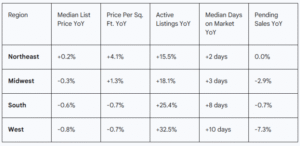
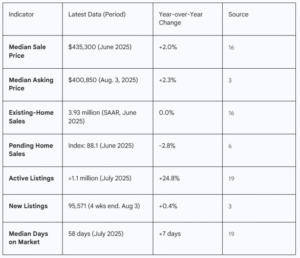
Recent housing data can be misleading. While June’s median sale price hit a record $435,300, this is a lagging indicator reflecting contracts signed in the spring. More current, forward-looking data shows a cooling market. The Pending Home Sales Index fell in June, signaling weaker sales ahead. Furthermore, median asking prices in early August saw one of their smallest year-over-year gains in two years, and list prices are already declining in the South and West, indicating that seller leverage is fading.

Inventory and Time on Market: More Choice, Less Urgency

Buyers now have more choices, as the inventory of homes for sale rose 24.8% year-over-year in July. However, this is a “passive” increase driven by cooling demand, not a flood of new sellers; new listings remain flat. Homes are simply sitting on the market longer—a median of 58 days in July, a full week longer than last year. This has allowed supply to accumulate to 3.9 months, moving closer to a balanced market. The market is characterized by stagnation, not a supply glut, making the rebalancing fragile.

August 2025 Housing Market Update Chart Sources Above: Realtor.com (July 2025) for Price, Listings, and Days on Market; NAR (June 2025) for Pending Sales

Key Market Indicators

Indicator Value Change
30-Year Fixed Mortgage Rate 6.63% Lowest since April
Median Sale Price (June) $435,300 Record high
Inventory (July) — +24.8% YoY
Days on Market (July) 58 days +7 days YoY
Months of Inventory 3.9 months Approaching balance
Pending Home Sales (June) — Declining

The Human Element: Decoding Buyer and Seller Behavior

Underlying the market statistics are powerful demographic trends that explain the market’s resilience and its contradictions. A generational wealth transfer and a rebound in foreign investment are creating a strong price floor.

The Great Wealth Transfer: Boomers Take the Lead

A major generational shift is reshaping the market. Baby Boomers (ages 60-78) are now the largest group of homebuyers at 42%, overtaking Millennials. Leveraging decades of home equity, nearly half of Boomer buyers pay in all-cash, putting a floor under prices. This has made it difficult for younger, financing-dependent buyers, whose share of the market has fallen to a historic low of 24%. This dynamic explains the paradox of high prices coexisting with a severe affordability crisis.

The Return of the International Buyer

Adding to demand, foreign investment in U.S. homes surged 33% to $56 billion. Buyers from China, Canada, and Mexico lead the trend, concentrating their purchases in states like Florida, California, and Texas. Like Boomers, nearly half of these buyers pay in cash and purchase more expensive properties, providing another layer of price support in key markets.

Buyer & Seller Demographics

Category Statistic
Dominant Buyer Group Baby Boomers: 42% (Millennials: 29%)
Cash Buyers (Boomers) Nearly 50% all-cash purchases
First-Time Buyers Historic low: 24%
International Buyers $56B in U.S. real estate (33% surge)
Foreign Cash Buyers Nearly 50% all-cash purchases

Policy Watch: Washington’s Bipartisan Push on Housing Supply

In a significant policy shift, Washington is showing rare bipartisan consensus to tackle the housing crisis by focusing on supply, not just demand. Two key bills lead this effort.

The One Big Beautiful Bill Act boosts affordable housing construction by expanding tax credits and easing financing for developers. More comprehensively, the Renewing Opportunity in the American Dream (ROAD) to Housing Act of 2025 passed unanimously out of its Senate committee and aims to break down local barriers to construction by incentivizing zoning reform, streamlining permitting, and reducing regulatory burdens. This long-term strategy to build more homes could eventually ease the inventory shortage and create new opportunities across the housing industry.

Concluding Analysis & Forward Outlook

The housing market will remain “stuck” for the rest of 2025, caught between the opposing forces of lower rates and a weaker economy. While a major price crash is unlikely due to a price floor set by cash-heavy Boomer and international buyers, the market is clearly rebalancing. Transaction volume will stay low, and national home prices are forecast to remain flat or decline slightly.

For Homebuyers: Cautious Opportunity

Lower rates, more inventory, and greater negotiating power create the best buying conditions in over a year. However, economic uncertainty demands financial prudence.

For Home Sellers: Strategic Realism

The peak of seller power has passed. Price your home for today’s market, not last spring’s. Be prepared for longer days on market and negotiations.

Connect with a Loan Officer

Sources

  • Mortgage Rates Continue to Decrease – GlobeNewswire, accessed August 12, 2025
  • U.S. Mortgage Rates Dip to Four Month Low in Early August – The World Property Journal
  • Buyers, Take Note: Mortgage Rates Are Falling, Home-Price Growth – Redfin
  • Employment Situation Summary – 2025 M07 Results – BLS
  • Pending Home Sales Drop in June as Buyers Struggle With Affordability – Realtor.com
  • NAR Pending Home Sales Report Shows 0.8% Decrease in June – GlobeNewswire
  • July 2025 Housing Market Trends Report – Realtor.com Research
  • Four Takeaways from NAR’s New Generational Trends Report
  • 2025 International Buyers in U.S. Real Estate – NAR Report
  • Federal Housing Policy Update – California Council
  • Banking Committee Passes Bipartisan ROAD to Housing Act – NLIHC
  • United States Housing Market & Prices – Redfin