Six NewFed Mortgage Professionals Featured in NAHREP Top 250 Latino Mortgage Originators

August 5, 2026

Celebrating Our NAHREP Top 250 Honorees

At NewFed Mortgage, representation matters — in the communities we serve, the partnerships we build, and the professionals we empower. That’s why we’re proud to announce that six of our outstanding loan officers have been recognized in the 2024 NAHREP Top 250 Latino Mortgage Originators list — a national ranking that honors top-producing mortgage professionals who serve a significant number of Latino homebuyers across the U.S.

Meet Our Honorees

GF

Gwen Fay

Loan Officer

AD

Andrew Distefano

Loan Officer

DC

Danielle Courtemanche

Loan Officer

MB

Michael Bornstein

Loan Officer

RG

Rich Garofalo

Loan Officer

NE

Nolis Espinal

Loan Officer

These professionals represent more than production numbers — they embody the values of trust, education, and advocacy that drive homeownership forward. Whether guiding first-time buyers or supporting long-term wealth-building, their work creates real impact in the communities we serve.

About NAHREP

The National Association of Hispanic Real Estate Professionals (NAHREP) is a mission-driven organization focused on advancing sustainable Hispanic homeownership. With over 40,000 members and local chapters nationwide, NAHREP blends entrepreneurial spirit, cultural heritage, and advocacy to empower Latino professionals and the families they support.

NAHREP’s Top 250 list is more than an industry accolade — it’s a celebration of influence, resilience, and service. NAHREP’s recognition highlights mortgage professionals who go above and beyond to support Latino clients and families on their homeownership journey. It’s about more than numbers — it’s about building trust, expanding access, and making a lasting difference. We’re proud to celebrate that mission alongside them.

Through policy advocacy in Washington, national events, and platforms like the Hispanic Wealth Project, NAHREP ensures that housing policy reflects the aspirations of one of the fastest-growing homebuyer demographics in the country.

Why This Recognition Matters

As the Latino homebuyer population grows, so does the need for mortgage professionals who understand the cultural and financial nuances that shape buying decisions. The loan officers recognized by NAHREP — including our own — are actively bridging that gap.

At NewFed Mortgage, we believe in showing up for the communities we serve — and that starts with building a team that reflects them. We equip our loan officers with the tools, training, and support they need to grow their business and serve every homebuyer with care. When we invest in our people, they’re empowered to make a difference where it matters most.

Looking Ahead

We applaud Gwen Fay, Andrew Distefano, Danielle Courtemanche, Michael Bornstein, Rich Garofalo, and Nolis Espinal not only for this recognition, but for the work they do every day to make homeownership more accessible and more meaningful for the families they serve.

To learn more about NAHREP’s mission, advocacy, and upcoming events, visit nahrep.org.

To connect with a NewFed Mortgage loan officer, visit newfed.com/team.

We’re Hiring!

If you’re a loan officer who believes in leading with service, building trust across communities, and making a lasting impact — we’d love to connect.

We’re hiring in every state we’re licensed in! Check out the areas we serve or submit your application today.
View Open Positions
Submit Application

What Every First-Time Homebuyer Should Know Before Getting Pre-Approved

August 5, 2026

Investing in property is an exciting and daunting process.

Just like most things, one of the hardest parts can be just getting started. What every first-time homebuyer should know before getting pre-approved is that this first step lays the groundwork for everything that follows. At NewFed Mortgage, we work to help our clients get through challenges and into a home they can be proud of.

Let’s get you started on your path to homeownership by addressing the most important question first: where should you even start? The answer is with a pre-approval.

What Is a Pre-Approval?

Pre-approval is a lender’s written offer stating how much you may be able to borrow based on your credit, income, and assets. It’s not a guarantee, but it shows sellers you’re serious and ready to buy. This is not to be confused with a pre-qualification.

Pre-Approval vs Pre-Qualification: What’s the difference?

These two mortgage terms are often confused, but they serve very different purposes in the homebuying process—especially for first-time buyers.

Pre-Qualification Pre-Approval
A quick estimate of what you might be able to borrow A formal, verified review of your finances by a lender
Based on self-reported income, debts, and credit Requires documentation (income, assets, credit score)
Often completed online or in a short conversation Results in a pre-approval letter you can submit with offers
Not verified by documents or credit pull Helps you shop confidently and signals you’re a serious buyer
Good for early-stage planning, but not taken seriously by sellers Often valid for 60–90 days, depending on the lender

Why Pre-Approval Matters

One of the most important steps in the mortgage process is getting pre-approved.

This shows sellers that you are serious and gives you an idea of what you can afford, helping you build credibility, house hunt with confidence, and lay out the foundation for budgeting wisely.

Your NewFed Loan Officer will review your credit, income, debts, and assets to determine what loan options you qualify for. Understanding this process is key to what every first-time homebuyer should know before getting pre-approved.

Common Mistakes First-Time Buyers Make

Even if you’re financially ready, it’s easy to make small mistakes that can delay—or derail—your mortgage pre-approval. Here’s what every first-time homebuyer should know before getting pre-approved when it comes to avoiding these pitfalls:

🚫 Changing Jobs or Income Sources

Lenders look for employment and income stability. A job change (even for more money) can raise red flags during underwriting.

🚫 Opening New Credit Accounts

Avoid applying for new credit cards, car loans, or financing plans while going through pre-approval. These can affect your credit score and debt-to-income ratio.

🚫 Making Large Unexplained Deposits or Withdrawals

Lenders need to trace the source of your funds. Sudden or undocumented transfers can complicate the process or cause delays.

🚫 Ignoring Credit Issues

Pre-approval includes a credit check. It’s best to address any disputes, late payments, or high balances beforehand to improve your options.

🚫 Assuming Pre-Approval Means Guaranteed Financing

Pre-approval is a strong step—but it’s not a final loan commitment. Avoid overextending your budget or skipping the next steps in the mortgage process.

What You’ll Need to Apply

Getting pre-approved usually takes between 3-5 days. Coming prepared can help speed things along. Save this section as a checklist! It’s one of the most practical pieces of what every first-time homebuyer should know before getting pre-approved.

Here is a brief breakdown of what documents you should have accessible when getting pre-approved:

  • The two most recent years’ W2s
  • Two most recent years’ tax returns (personal & business if applicable)
  • The two most recent pay stubs
  • The two most recent months’ bank statements
  • The two most recent months’ 401K or retirement statement
  • Copy of the front of a valid driver’s license

How To Decide If You’re Ready To Get Pre-Approved

To make this process smoother, there are a few things you should consider before contacting your loan officer.

First, are you ready to buy?

This may seem obvious, but there is more to consider than you might think. Consider if you are ready to commit to a home (you’ll be living here for quite some time), if you have the capital for a down payment, if your credit score could help or hinder your loan options, and if you qualify for any assistance (such as first-time homebuyer programs).

Second, are your finances sound, secure, and not subject to change?

Purchasing a new home can be expensive, and as we have discussed, it is necessary to have the funds for the initial down payment. Are you in a place where your finances are stable? Changing jobs, salary fluctuation, missing credit card or loan payments, or changing your financial situation in any way can create difficulty in the loan process.

Third, is your family unit changing?

This is an important thing to consider before settling down. If you are planning on getting married, divorced, having a child, or caring for a loved one, then you should consider what property you may want to purchase, and how your family unit may change your expenses.

Take The First Steps with Confidence

Not sure if you are ready?

That’s okay! If you aren’t quite ready to commit, you can still chat with one of our Loan Officers to discuss your plans.

For more information on what loan options are available to you, and how your financial situation may affect your choices, reach out to our team today!

Find A Loan Officer

July 2025 Housing Market Update: Rates, Prices & Policy Changes

August 5, 2026

July 2025 Housing Market Update: A Mid-Year Look at Housing Trends, Economic Signals, and Legislative Updates

As your trusted partner in home financing, we’re excited to bring you this July 2025 housing market update—a high-level overview of the current housing landscape, key economic indicators, and legislative changes affecting buyers, sellers, and industry professionals.

Our goal is to provide insights that empower homeowners, first-time buyers, real estate agents, insurance professionals, attorneys, and all members of our community to make well-informed decisions. With signs of stabilization and potential growth ahead, there’s reason for optimism as we move through the second half of 2025.

📈 July 2025 Housing Market Update: Trends and Buyer Activity

Resilience in Sales and Buyer Confidence

The U.S. housing market continues to show strength in mid-2025, with modest sales growth and a gradual easing of challenges that buyers have faced in recent years.

According to the National Association of Realtors (NAR), existing-home sales increased 0.8% month-over-month in May, reaching a seasonally adjusted annual rate of 4.03 million. While sales are down slightly by 0.7% year-over-year, the monthly uptick reflects improving buyer confidence—despite ongoing inventory constraints.

Home Prices and Housing Forecasts

  • Zillow reports the average U.S. home value at $369,147, up 0.5% year-over-year.
  • Redfin noted a 0.6% increase in May median prices, with several markets reaching record highs.
  • Zillow forecasts a potential 1.4% decline in home values over the remainder of 2025, which may improve affordability for first-time buyers and move-up shoppers.

Pending Sales and Competitive Dynamics

Pending sales fell 3.5% year-over-year (Redfin), suggesting the market may be cooling slightly. This may reduce buyer competition and lead to more negotiable conditions and pricing opportunities—a key point in this July 2025 housing market update.

International and Generational Buyer Trends

Foreign investment in U.S. homes surged to $56 billion from April 2024 to March 2025—a 33% increase year-over-year (NAR), showing continued international interest in U.S. real estate.

Meanwhile, Gen Z buyers (ages 18–25) accounted for just 3% of home purchases, highlighting affordability challenges but pointing to long-term growth potential as market conditions evolve.

Mortgage Rate Trends and Market Outlook

Mortgage rates are stabilizing. According to Freddie Mac, 30-year fixed rates averaged 6.7% in early July 2025. As rates settle, refinance and purchase activity may increase—creating momentum for both current homeowners and buyers entering the market.

🏛️ July 2025 Housing Policy Updates: Legislative Changes Impacting Homeownership

Expanded Tax Relief for Homeowners

Recent federal legislation includes the restoration of mortgage insurance deductions and expanded SALT (state and local tax) deductions. These changes provide tax relief for homeowners—especially those with lower down payments or who live in higher-tax states.

In addition, permanent extensions of Qualified Business Income deductions and Opportunity Zones benefit professionals and investors with long-term tax planning options.

Federal Efforts to Expand Housing Supply

Incentives for new home construction are gaining traction, aiming to ease inventory shortages and improve price stability.

Expanded low-income housing tax credits could generate over one million affordable rental units in the next decade—helping address supply gaps in underserved communities.

Property Investment and Estate Planning

The reinstatement of full expensing for improvements and equipment is motivating both residential and commercial development.

Estate tax thresholds have also increased, supporting multigenerational planning and property preservation strategies.

Strengthening Fair Lending and Access

Provisions to enhance fair lending practices aim to expand equitable access to homeownership while reducing structural barriers.

New policies are in place to enhance fair lending practices and promote equitable access to homeownership.

For attorneys, real estate agents, and financial advisors, this July 2025 housing market update highlights an important opportunity to advise clients on tax-advantaged strategies and compliance shifts.

💡 What These Housing Insights Mean For You

The landscape is shifting in favor of increased opportunity—whether you’re:

  • A first-time buyer watching rate trends,
  • A homeowner considering a refinance or sale, or
  • A real estate partner or advisor helping others navigate their next step.

This July 2025 housing market update reflects a promising landscape, with steady rate improvements, increasing affordability incentives, and favorable conditions for long-term growth.

Stay Ahead with Personalized Financing Guidance

At NewFed Mortgage, we’re tracking these market trends and policy updates closely. Whether you’re buying, refinancing, or advising others—we’re here to help you make confident, informed decisions.

👉 Connect with us today for a personalized financing strategy tailored to your goals.

Sources

  • NAR Existing-Home Sales Report – June 2025
  • Zillow U.S. Home Value Index – July 2025
  • Redfin Housing Market Update – June 2025
  • Zillow Forecast: Home Values – June 2025
  • Redfin Pending Sales Decline – June 2025
  • NAR International Transactions Report – July 2025
  • NAR Generational Trends Report – April 2025
  • Freddie Mac Mortgage Market Survey – July 2025
  • Federal Reserve Economic Projections – June 2025
  • Tax Foundation – 2025 Tax Reform Summary
  • Investopedia – Housing Incentives Breakdown

How Much Do You Really Need for a Down Payment? (Less Than You Think)

August 5, 2026


One of the most common misconceptions in the homebuying process is that you need 20% down to get started. That’s simply not true. With today’s loan programs and down payment assistance options, many buyers can qualify with much less—or even zero down. When you understand what’s available, you’ll feel more confident taking the next step: getting pre-approved with a local mortgage lender.

Myths About Down Payments & Homeownership

Despite what you may have heard, down payments don’t have to be intimidating—and they definitely don’t have to be the reason you’re waiting to take action.

Some think you need a large amount saved up before you even talk to a lender. Others believe help is only available to low-income borrowers—or that you can’t use gift money from a relative or partner. The truth is, there are flexible options out there designed to meet buyers where they are.

You don’t need 20% down.

Many first-time homebuyers qualify with as little as 3%–5% down—and some programs require no down payment at all. Don’t let the 20% myth delay your homeownership goals unnecessarily.

Down Payment Assistance isn’t just for low-income buyers.

Some programs are income-based, yes—but many are designed to help middle-income buyers, too. In fact, NewFed’s National DPA Program is available to borrowers earning up to 140% of the area median income.

You can use gift funds to cover your down payment.

In many cases, down payments can be partially or fully covered by gifts from family members or even domestic partners. Your loan officer can guide you through how to document the funds—it’s more common than you might think.

You don’t need to have everything saved before you apply.

Getting pre-approved early helps you understand what’s actually required—and often unlocks options you may not know you qualify for. Talking to a lender upfront is one of the smartest first steps you can take.

What Do I Really Need to Save?

While upfront costs vary for each person and property, you can typically expect to plan for a down payment, closing costs, and home inspection costs.*

Down Payment

It typically ranges from 0% to 20%, depending on your loan type. Some programs, including those from NewFed Mortgage, may allow lower down payments or help.

Closing Costs

Usually 2–5% of the home’s purchase price. These can include appraisal fees, title insurance, lender fees, prepaid taxes, and more.

Home Inspections

A general home inspection is strongly recommended. The buyer usually pays for it out of pocket before closing (often $300–$600).

Other upfront costs may include earnest money, prepaid costs, moving costs, and more. It’s important to consult with a mortgage loan officer for the full picture.

Explore Down Payment Options

There’s good news for first-time and repeat buyers alike: down payment assistance exists at nearly every level—federal, state, and even local. These programs are designed to reduce the upfront financial burden and make homeownership more accessible, especially in high-cost markets or for buyers with limited cash savings.

Many of these assistance programs come in the form of grants, forgivable loans, or deferred payment options. Some are tied to specific loan types (like FHA or USDA), while others are connected to your location or income bracket. To help buyers navigate what’s available, Fannie Mae offers a useful tool that identifies potential down payment assistance programs based on your location and eligibility. You can explore it here.

By exploring these resources early, you’ll gain a clearer picture of what’s possible—and may find that homeownership is closer than you thought.

Save with NewFed Mortgage’s Down Payment Assistance Programs

NewFed Advantage Down Payment Assistance Program

This option allows eligible buyers to finance their home with 0% down, removing difficult financial barriers. Nothing should stand in the way of homeownership, and NewFed is here to help.

NewFed National Down Payment Assistance Program

If you are earning up to 140% of the area’s median income, you are potentially eligible to access up to 97% LTV down payment options. Discuss this option with our loan officers to determine if this is for you, and to increase your homebuying power.

Mortgage Loans with Down Payment Flexibility

When it comes to buying a home, one size doesn’t fit all—and neither does one loan type. The good news? There are several mortgage programs built specifically to support buyers who may not have a large down payment saved. Whether you’re purchasing in a rural area, serving in the military, or working through unique credit or identification situations, there are lending options designed to meet you where you are.

Here’s a look at some of the most accessible loan programs with flexible down payment requirements:

FHA Loans

Insured by the Federal Housing Administration, FHA loans are ideal for buyers with lower credit scores or limited savings. Down payments can be as low as 3.5%, making this a popular option for first-time buyers or those re-entering the market.

USDA Loans

Backed by the U.S. Department of Agriculture, these loans offer zero down payment for eligible buyers purchasing in designated rural and suburban areas. USDA loans are income-based and provide affordable financing with competitive terms.

VA Loans

Available to eligible veterans, active-duty service members, and surviving spouses, VA loans require no down payment and no monthly mortgage insurance. These loans are a well-deserved benefit for those who’ve served—and one of the most powerful financing tools available.

State & Local Housing Programs

Many states, counties, and municipalities offer buyer assistance through Housing Finance Agencies (HFAs). These programs often include grants or low-interest second loans for down payments or closing costs, and may also feature reduced rates or tax credits. A loan officer can help you explore what’s available in your area. Ask us about state-level programs like MassHousing!

Alternative ID or Credit-Based Loans

Not all qualified borrowers fit a traditional credit or identification profile. For buyers without a Social Security Number, Individual Taxpayer Identification Number (ITIN) programs may offer a path to homeownership. These loans are designed to support more inclusive access to mortgage financing.

More Ways NewFed Mortgage Helps You Save

In addition to down payment assistance and flexible mortgage options, NewFed Mortgage offers a variety of exclusive savings programs designed to lower your upfront costs and reward the service, partnerships, and locations that matter most to us. Whether you’re a community hero, buying in a qualifying area, or working with one of our trusted real estate partners, we’ve built programs to support your financial goals and simplify your path to homeownership.

Here are just a few of the exclusive savings opportunities available to eligible buyers:

Community Champions Program

If you serve the community as a first responder, firefighter, police officer, teacher, state/city employee, or a medical professional, we have loans specifically designed for you! We proudly provide preferred rates and discounted fees for all our community’s heroes, because you deserve credit for all you do for us.

Community Lending Program

NewFed offers exclusive rate reductions or up to $4,500 towards closing costs for certain geographic areas. Check with one of our Loan Officers to see if you qualify for this program!

NewFed Edge Program

NewFed offers exclusive discounts if you work with one of our Real Estate Partners. If you work with one of the following, you are eligible for up to a .5% closing cost credit:

  • Coldwell Banker Town & Country
  • Century 21 Northeast
  • Century 21 Integra
  • Century 21 The Hills Realty

Take the First Step with Confidence

Whether you’re a first-time homebuyer exploring your options or someone ready to take the next step, NewFed Mortgage is here to help you save more and stress less. With down payment assistance, exclusive savings programs, and personalized loan guidance, our team is committed to making homeownership more accessible—no matter where you’re starting from.

Ready to see what you’re eligible for? Connect with a NewFed Loan Officer today to explore your options, ask questions, and get one step closer to owning your home with confidence.

Connect With a Loan Officer

NewFed Mortgage Strengthens Leadership to Drive Efficiency and Growth

August 5, 2026

NewFed Mortgage Leadership Updates: Strengthening Our Foundation for Growth

At NewFed Mortgage, we’re all in — on growth, on operational excellence, and on delivering a streamlined, customer-first mortgage experience. Our latest NewFed Mortgage leadership updates reflect that commitment by strengthening our infrastructure and empowering our teams to scale with confidence and care.

A Leadership Structure Built for Efficiency and Expansion

As our national footprint expands and our service offerings evolve, having the right people in the right roles has never been more important. These NewFed Mortgage leadership updates are a strategic investment in our people and our process — built to support every stage of the mortgage lifecycle while making life easier for both our team members and our clients.

PS

Pam Silver

VP of Loan Operations & Development

Pam now oversees Processing, Loan Opening, and our Loan Officer Assistant team, in addition to continuing her leadership of Learning & Development. This alignment ensures that training programs are not only best-in-class but also directly connected to day-to-day loan operations. The result? Improved efficiency, greater accuracy, and a faster, smoother mortgage experience for our borrowers and partners.

CW

Cheri Wright

VP of Fulfillment & Credit Risk Operations

Cheri, a consistent pillar of our Underwriting team, now leads Closing and Post-Closing as well — giving her full visibility into the entire fulfillment process. This move allows us to maintain quality and consistency from credit decision to investor delivery, reinforcing our commitment to excellence through every loan we fund.

EP

Eric Portnoy

EVP, National Sales Operations

Eric steps into a newly elevated role as the national field leader of our sales organization. With a focus on performance, accountability, and production support, Eric will serve as a key driver of originator success. His thoughtful leadership ensures that our sales force is equipped and empowered at every level, every day.

HP

Hans Plum

EVP, National Strategic Sales & Growth

Hans will lead our efforts in scaling smart — supporting market expansion, sales infrastructure, and onboarding processes that help us grow the right way. His ability to turn strategy into action makes him a cornerstone of our future-forward sales organization.

Employee headshots for those included in the NewFed Mortgage leadership updates August 2025

PS

Pam Silver

CW

Cheri Wright

EP

Eric Portnoy

HP

Hans Plum

Why These NewFed Mortgage Leadership Updates Matter

These promotions are more than just title updates — they represent our continued momentum as a company. They reinforce our culture of empowerment, collaboration, and progress. And they reflect the values we’ve upheld since day one:

Integrity in Execution

Every decision we make is grounded in what’s best for our borrowers, our partners, and our people.

Innovation with Purpose

We embrace change when it drives smarter, faster, more efficient solutions.

Family at the Core

We support one another like family, creating a culture where people thrive — not just work.

By aligning leadership with the evolving needs of our departments and our customers, we’re ensuring that our growth is intentional, sustainable, and deeply rooted in service.

Looking Ahead

As NewFed Mortgage continues to grow across the country, we remain committed to the same core promise: making the mortgage process better — for everyone involved. Whether you’re a first-time homebuyer, a seasoned investor, or a loan officer looking for a supportive home base, our team is built to support you every step of the way.

Please join us in congratulating Pam, Cheri, Eric, and Hans on their well-earned promotions. We’re confident that with their leadership, the best is yet to come.

Ready to learn more about the people behind the process?

Explore who we are and how we work by reaching out today! Whether you’re a homebuyer, an industry partner, or on the hunt for your next career move – we’re just a phone call away.

📞 (877) 639-3331

Contact Us Today

August 2025 Housing Market Update: Rates & Buyer Confidence

August 5, 2026

A Housing Market of Contradictions

The late summer housing market is defined by a key contradiction: mortgage rates have fallen to their lowest point since April, boosting buyer affordability, but this relief is a direct result of a stalling national labor market. July’s jobs report showed negligible growth after massive downward revisions for May and June, cooling the economy and pushing down borrowing costs. This dynamic creates a “stuck” market where improved affordability is met with economic uncertainty, eroding consumer confidence. As a result, forward-looking indicators like pending home sales show persistent declines, suggesting the market has yet to find momentum. In this August 2025 housing market update, we break down the latest mortgage rate shifts, buyer behavior, and forward-looking economic trends.

The Economic Backdrop: Cooling Inflation and a Stalling Jobs Engine

The economy is sending conflicting signals that are shaping the housing market. A significant slowdown in the labor market is pushing mortgage rates down, while stubborn inflation creates uncertainty about the Federal Reserve’s future policy.

The Labor Market’s Warning Shot

The July jobs report revealed a significant economic slowdown. While the unemployment rate held at 4.2%, payrolls grew by a mere 73,000. More importantly, massive downward revisions for May and June erased a combined 258,000 previously reported jobs, showing the economy was stagnant through the spring. This lack of job creation, a key driver of housing demand, is amplified by a rise in long-term unemployment and a declining labor force participation rate. This weakness erodes consumer confidence, likely offsetting some of the benefits of lower mortgage rates.

Inflation’s Stubborn Plateau

Despite the cooling labor market, inflation remains stubbornly above the Federal Reserve’s 2% target. The Producer Price Index showed that both headline and core inflation rose by 0.3%, which was much hotter than the 0.2% expected. It does appear that the tariffs are finally showing up in the data…but taking yesterday’s CPI and PPI reports together, we can derive that a lot of the cost is currently being absorbed along the supply chain. This puts the Fed in a difficult position: the weak job market calls for rate cuts, but high inflation calls for holding steady. This conflict creates uncertainty and suggests the current low-rate environment may be a temporary window for buyers.

The Rate Retreat: A Quantifiable Boost to Affordability

Mortgage rates have fallen significantly, providing a tangible boost to affordability. The average 30-year fixed rate dropped to 6.63% in early August, its lowest level since April. This retreat from May’s peak has a quantifiable impact: a buyer with a $3,000 monthly budget can now afford a home worth about $20,000 more. The market has responded immediately, with mortgage applications rising 2% week-over-week and up 18% from last year, demonstrating that pent-up demand is highly sensitive to rate changes.

August 2025 Housing Market Update: Rebalancing Across Regions

The national housing market is clearly cooling and rebalancing, though the process is uneven across the country. It is critical to look at forward-looking data to understand the current trajectory.

Sales and Pricing: A Tale of Two Timelines

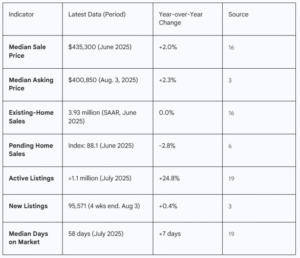
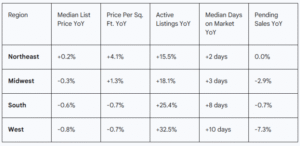
Recent housing data can be misleading. While June’s median sale price hit a record $435,300, this is a lagging indicator reflecting contracts signed in the spring. More current, forward-looking data shows a cooling market. The Pending Home Sales Index fell in June, signaling weaker sales ahead. Furthermore, median asking prices in early August saw one of their smallest year-over-year gains in two years, and list prices are already declining in the South and West, indicating that seller leverage is fading.

Inventory and Time on Market: More Choice, Less Urgency

Buyers now have more choices, as the inventory of homes for sale rose 24.8% year-over-year in July. However, this is a “passive” increase driven by cooling demand, not a flood of new sellers; new listings remain flat. Homes are simply sitting on the market longer—a median of 58 days in July, a full week longer than last year. This has allowed supply to accumulate to 3.9 months, moving closer to a balanced market. The market is characterized by stagnation, not a supply glut, making the rebalancing fragile.

August 2025 Housing Market Update Chart Sources Above: Realtor.com (July 2025) for Price, Listings, and Days on Market; NAR (June 2025) for Pending Sales

Key Market Indicators

Indicator Value Change
30-Year Fixed Mortgage Rate 6.63% Lowest since April
Median Sale Price (June) $435,300 Record high
Inventory (July) +24.8% YoY
Days on Market (July) 58 days +7 days YoY
Months of Inventory 3.9 months Approaching balance
Pending Home Sales (June) Declining

The Human Element: Decoding Buyer and Seller Behavior

Underlying the market statistics are powerful demographic trends that explain the market’s resilience and its contradictions. A generational wealth transfer and a rebound in foreign investment are creating a strong price floor.

The Great Wealth Transfer: Boomers Take the Lead

A major generational shift is reshaping the market. Baby Boomers (ages 60-78) are now the largest group of homebuyers at 42%, overtaking Millennials. Leveraging decades of home equity, nearly half of Boomer buyers pay in all-cash, putting a floor under prices. This has made it difficult for younger, financing-dependent buyers, whose share of the market has fallen to a historic low of 24%. This dynamic explains the paradox of high prices coexisting with a severe affordability crisis.

The Return of the International Buyer

Adding to demand, foreign investment in U.S. homes surged 33% to $56 billion. Buyers from China, Canada, and Mexico lead the trend, concentrating their purchases in states like Florida, California, and Texas. Like Boomers, nearly half of these buyers pay in cash and purchase more expensive properties, providing another layer of price support in key markets.

Buyer & Seller Demographics

Category Statistic
Dominant Buyer Group Baby Boomers: 42% (Millennials: 29%)
Cash Buyers (Boomers) Nearly 50% all-cash purchases
First-Time Buyers Historic low: 24%
International Buyers $56B in U.S. real estate (33% surge)
Foreign Cash Buyers Nearly 50% all-cash purchases

Policy Watch: Washington’s Bipartisan Push on Housing Supply

In a significant policy shift, Washington is showing rare bipartisan consensus to tackle the housing crisis by focusing on supply, not just demand. Two key bills lead this effort.

The One Big Beautiful Bill Act boosts affordable housing construction by expanding tax credits and easing financing for developers. More comprehensively, the Renewing Opportunity in the American Dream (ROAD) to Housing Act of 2025 passed unanimously out of its Senate committee and aims to break down local barriers to construction by incentivizing zoning reform, streamlining permitting, and reducing regulatory burdens. This long-term strategy to build more homes could eventually ease the inventory shortage and create new opportunities across the housing industry.

Concluding Analysis & Forward Outlook

The housing market will remain “stuck” for the rest of 2025, caught between the opposing forces of lower rates and a weaker economy. While a major price crash is unlikely due to a price floor set by cash-heavy Boomer and international buyers, the market is clearly rebalancing. Transaction volume will stay low, and national home prices are forecast to remain flat or decline slightly.

For Homebuyers: Cautious Opportunity

Lower rates, more inventory, and greater negotiating power create the best buying conditions in over a year. However, economic uncertainty demands financial prudence.

For Home Sellers: Strategic Realism

The peak of seller power has passed. Price your home for today’s market, not last spring’s. Be prepared for longer days on market and negotiations.

Connect with a Loan Officer

Sources

  • Mortgage Rates Continue to Decrease – GlobeNewswire, accessed August 12, 2025
  • U.S. Mortgage Rates Dip to Four Month Low in Early August – The World Property Journal
  • Buyers, Take Note: Mortgage Rates Are Falling, Home-Price Growth – Redfin
  • Employment Situation Summary – 2025 M07 Results – BLS
  • Pending Home Sales Drop in June as Buyers Struggle With Affordability – Realtor.com
  • NAR Pending Home Sales Report Shows 0.8% Decrease in June – GlobeNewswire
  • July 2025 Housing Market Trends Report – Realtor.com Research
  • Four Takeaways from NAR’s New Generational Trends Report
  • 2025 International Buyers in U.S. Real Estate – NAR Report
  • Federal Housing Policy Update – California Council
  • Banking Committee Passes Bipartisan ROAD to Housing Act – NLIHC
  • United States Housing Market & Prices – Redfin

Momentum in Motion: Building Progress That Powers People

August 5, 2026

Momentum in Motion: NewFed’s 2025 Journey

At NewFed Mortgage, Momentum is our word for 2025. It captures the spirit of steady progress — moving forward with purpose, together. And for this quarter, our rally cry is Momentum in Motion: a reminder that momentum isn’t just an idea, it’s an action.

This past week, we came together for our all-company Town Hall — the first in over a year and a half. It was more than just an update; it was a conversation built on communication and collaboration. Across departments, leaders shared the progress we’ve made so far this year and how we’re working in unison to reach our year-end production goal.

The story that emerged was clear: momentum is alive across every part of NewFed, and when we move together, the impact multiplies.

Helping More Families Home

Momentum starts with the people we serve. So far this year, nearly 900 families have already chosen NewFed to guide them into homeownership — almost 50% more than the same point last year. Each loan tells its own story: a first-time buyer finally getting keys, a growing family finding more space, a retiree downsizing with confidence.

Loan Officer & Market Expansion

Behind these numbers is the growth of our team. With 29 new loan officers and licenses added in five more states, our local expertise now extends further than ever. That means more communities with access to NewFed’s trusted guidance, faster approvals, and a family-first culture that puts people at the center of every transaction.

Smoother Closings, Happier Clients

When the process is smooth, everyone feels it — clients breathe easier, Realtors celebrate faster, and loan officers get to focus on relationships instead of roadblocks.

Efficiency Gains and First eClose

So far this year, our operations team has reduced processing times by more than 15%, while boosting efficiency by nearly 40%. For clients, that means less waiting and more celebrating.

We also celebrated our first eClose this year and saw record adoption of nCino, a digital platform that streamlines steps and cuts down on errors. Every improvement is aimed at the same outcome: closings that are faster, cleaner, and more collaborative — allowing sales and operations to move in sync and keep momentum flowing.

Staying Connected, Building Confidence

Momentum thrives when people are engaged. That’s why our marketing team has expanded outreach in ways that connect more clients and Realtors to NewFed than ever before.

So far this year, monthly newsletters have reached 70,000+ contacts with strong open rates, while a new weekly Realtor update goes out to 22,000 agents nationwide. These aren’t just sends — they’re conversations, with engagement rates consistently outperforming industry benchmarks.

Engagement Above Industry Averages

Behind the scenes, 83 automated journeys are nurturing prospects into applications, while Customer Intelligence alerts have already fueled over $29 million in funded volume. And with a brand-new recruitment website launching this month, it’s never been easier for loan officers to explore how they can put their own momentum in motion at NewFed.

Innovation & Security Behind the Scenes

Momentum is only possible when the systems powering it are reliable and safe. Our IT team works 24/7 to make sure that’s the case.

AI-Driven Automation and Cybersecurity

So far this year, they’ve blocked thousands of cyber threats, filtered millions of emails, and maintained more than 160 systems with near-perfect uptime. They’ve also introduced AI-driven automation inside Encompass, cutting down on manual work so employees can focus on what matters most: serving people.

It’s progress you might not always see, but you feel it in every faster response, smoother file, and more confident client.

One Spark Fuels Another

Momentum is contagious. When sales bring in clean files, operations moves faster. When operations moves faster, Realtors trust more. When Realtors trust more, referrals grow. And all of it is supported by marketing visibility and IT reliability that make growth possible.

That’s the essence of Momentum in Motion. Every department pushing forward in unison toward one shared goal. And with three full months left in the year, we have the opportunity to finish strong and surpass expectations.

At NewFed, momentum isn’t just numbers, it’s people, progress, and partnership. And together, we’re just getting started.

Building Momentum Through Recognition

This quarter, we introduced a new way to celebrate the people driving our culture forward: The People Behind NewFed Recognition Wall.

Located at HQ, the wall will grow brick by brick with the names of team members recognized through the All In Awards. Each quarter, employees will nominate two peers who exemplify our values of Integrity, Innovation, Family, Accountability, and Momentum.

Winners will be honored with a custom-engraved brick featuring their name, the award, and the NewFed logo, a permanent reminder that our people are the foundation of our success.

This initiative reflects our belief that momentum doesn’t come from processes or tools alone. It comes from our people, those who go all in, support one another, and move NewFed forward every day.

Contact Us

September 2025 Housing Market Update: Rates Drop, Buyers Respond

August 5, 2026

September 2025 Housing Market Update

This September 2025 Housing Market Update highlights falling mortgage rates, renewed buyer demand, and the economic forces shaping real estate today. Affordability improved as rates dropped to an 11-month low, sparking a surge in applications. Yet, with job growth stalling and sellers remaining cautious, transaction volume is likely to stay muted even as buyers gain leverage.

Mortgage Rates & Buyer Activity

  • 30-Year Fixed Mortgage Rate: Fell to 6.25%, the lowest in 11 months.
  • Buyer Response: Mortgage application volume surged 9.2% in early September. Purchase applications rose 6.6%, while refinance activity jumped 12.2%.
  • Affordability Boost: The median U.S. mortgage payment dropped to $2,604, more than $200 below May’s peak. Buyers gained an additional $20,000 in purchasing power since midsummer.

The Economic Backdrop

  • Jobs Data: Only 22,000 jobs were added in August, far below the 75,000 forecast. Unemployment rose to 4.3%, the highest since 2021.
  • Long-Term Joblessness: 1.9 million Americans have been unemployed for 27 weeks or longer, representing 25.7% of all unemployed.
  • Inflation: The Consumer Price Index rose 2.9% year-over-year, marking the fourth straight monthly increase. Core inflation (excluding food and energy) remained elevated at 3.1%.
  • Policy Outlook: The Fed has signaled greater concern about labor market weakness, with markets now pricing in a likely 25-basis-point rate cut at the September 17th meeting.

National Housing Performance

Metric Value Change
Existing-Home Sales (July) 4.01M annual rate +2.0% MoM
Median Sale Price $422,400 +0.2% YoY
Pending Home Sales -0.4% MoM / +0.7% YoY
Active Listings +20.9% YoY
Days on Market 60 days +7 days YoY
Months of Inventory 4.6 months Approaching balance

Regional Trends

The national averages mask a growing divide:

  • Northeast & Midwest: Prices and demand remain resilient, though inventory is still far below pre-pandemic levels.
  • South & West: Former boomtowns are cooling, with falling prices, rising days on market, and inventory levels above pre-pandemic benchmarks.

This divergence is reshaping housing wealth. Florida, California, and Texas lost a combined $247 billion in value over the past year, while New York alone gained $216 billion.

Buyer & Seller Demographics

Category Statistic
Dominant Buyer Group Baby Boomers: 42% (Millennials: 29%)
Sellers Baby Boomers: 53% of listings
Cash Buyers (Older Boomers, 70-78) 51% all-cash purchases
First-Time Buyers Historic low: 24% (Median age: 38)
International Buyers $56B in U.S. real estate (50% cash)

Policy Developments

  • Federal Action: The ROAD to Housing Act of 2025 passed out of committee unanimously. Its focus: incentivizing zoning reform, streamlining permits, and promoting lower-cost housing options.
  • State Action: States like Texas, Washington, and Montana are enacting zoning, ADU, and parking reforms to accelerate new housing supply.

Concluding Analysis & Forward Outlook

The September 2025 housing market continues to balance affordability gains against economic headwinds. Lower rates have given buyers a welcome boost in purchasing power, but weak job growth and seller hesitation are limiting overall activity. A major price correction remains unlikely thanks to cash-heavy Baby Boomer buyers and international investors, yet transaction volume is expected to remain low through year-end as the market slowly rebalances.

For Homebuyers: Cautious Leverage

Mortgage rates at an 11-month low and a 20.9% increase in active listings provide the strongest negotiating position in over a year. With homes spending an average of 60 days on market, buyers have more time to evaluate options. Still, economic uncertainty and a three-year-high unemployment rate underscore the importance of careful financial planning.

For Home Sellers: Grounded Expectations

Flat prices and a projected 0.9% decline by year-end mean the peak of seller power has passed. Expect longer timelines, more negotiations, and buyers who are entering the market with increased leverage. Sellers who price homes for today’s market—not last spring’s highs—will be best positioned to achieve a successful sale.

Connect With a Loan Officer

Your Fall Homeowner Checklist: Protect, Prepare, and Save Before Winter Hits

August 4, 2026

As the leaves turn and temperatures drop, there’s more to fall than pumpkin spice and cozy evenings by the fire. It’s also the season to get your home ready for winter weather.

A little preparation now can help homeowners avoid unexpected repairs, lower utility bills, and protect their biggest investment: their home. Whether you’re a new homeowner or a seasoned pro, this fall home maintenance checklist can help you stay one step ahead.

Inspect Your Roof and Gutters

Falling leaves may be beautiful, but they can cause major headaches if they block your gutters or downspouts. Clogged gutters can lead to ice dams and water damage once temperatures dip. In fact, water damage and freezing accounted for 27.6 % of homeowners insurance claims in 2022.

Clear out leaves and debris, check for loose shingles, and make sure water flows away from your foundation. Consider installing gutter guards: a 2025 survey found that 63 % of homeowners saved at least four hours a year in gutter maintenance after installing them.

By taking these steps now, you can help prevent costly repairs and avoid structural damage before winter sets in.

Seal Windows and Doors to Keep Warm Air In

Drafts aren’t just uncomfortable, they’re costly. A simple inspection around windows and doors can save energy and money. The Department of Energy estimates you can save up to 20 % on heating bills by sealing drafts and replacing inefficient windows. Use weatherstripping or caulk to seal leaks, and check that window locks and seals are tight. If you notice cold air seeping in, it might be time for an upgrade that boosts comfort and resale value.

Sealing up your home now not only adds comfort for this season and protects against higher utility bills later.

Schedule a Furnace Tune-Up

Your heating system works hardest when you need it most. Don’t wait until the first cold night to find out it’s not performing at its best. Have a professional inspect and clean your HVAC system to ensure it’s efficient and safe for winter. Replace filters regularly to keep your system running smoothly.

While you’re at it, vacuum vents and baseboards to remove dust buildup — clean airflow helps your system run efficiently and improves indoor air quality.

An inefficient furnace costs more to operate and may fail early. A furnace failure puts you at risk when you need it most.

Check Smoke and Carbon Monoxide Detectors

With fireplaces, space heaters, and furnaces working overtime, fall is the perfect time to test your home’s safety systems. Replace batteries in smoke and CO detectors, and make sure every level of your home has at least one working alarm.
According to industry data, water damage and freezing issues are the second leading cause of insurance claims after wind and hail.

An unexpected malfunction or leak can trigger far more than a draft — it can lead to significant cost and risk.

Protect Your Pipes and Plumbing

Frozen pipes are one of winter’s most common (and costly) issues. For example, a small crack in a pipe can leak gallons of water a day, causing serious damage. Drain outdoor spigots, disconnect hoses, and wrap exposed pipes in unheated areas like basements or garages.

These inexpensive steps now can prevent expensive repairs later. The average frozen pipe repair can exceed $500 and sometimes runs into the thousands.

Fire Up Your Fireplace (Safely)

Before lighting the first fire of the season, make sure your chimney and flue are clean and in good working order. Schedule a professional inspection to remove creosote buildup and check for blockages. Safety first, comfort always.

A small investment in inspection now can save from major fire risk, structural damage, and homeowner disruption later.

Prep Outdoor Spaces for Winter

Patios, decks, and garden areas need care before freezing temps set in. Store or cover patio furniture, turn off irrigation systems, and trim trees or branches close to your roofline and power lines.

Taking care of your outdoor spaces now means less hassle and more enjoyment when spring rolls around.

Check Your Home’s Energy Efficiency

Now’s also a great time to review your home’s energy use. Consider an energy audit or small upgrades, like LED lighting or a smart thermostat, to cut utility costs and increase comfort. Reverse your ceiling fans to clockwise rotation — it helps push warm air back down, reducing heating costs.

And if you’re planning major improvements, your home’s equity can help fund energy-efficient upgrades or repairs before winter arrives. Ask your NewFed loan officer about options like home equity refinancing or renovation loans that make energy upgrades more affordable.

Talk to A Loan Officer

What a 50-Year Mortgage Could Mean for Homebuyers

August 4, 2026

What a 50-Year Mortgage Could Mean for Homebuyers

The idea of a 50-year mortgage is gaining attention. It’s being discussed as one way to help people who have decades—rather than the more common 30 years. It’s being discussed as one way to help people who want to buy a home but find monthly payments too high.

The hope: With more time to pay it back, the monthly payment is lower, making homeownership look easier to reach.

But there’s a flip side: You’ll pay more interest over the full time. You’ll build less home equity early on. You might still face tough approval rules. These risks are drawing a lot of professional scrutiny.

What is a 50-year mortgage?

Here’s how to think about a 50-year mortgage in simple terms:

  • A regular 30-year fixed mortgage means you pay back your loan over 30 years (360 monthly payments).
  • With a 50-year mortgage you’d spread those payments out over 50 years (600 monthly payments).
  • Because the payments are spread out more, the monthly payment is smaller, all else equal.
  • But because you’re paying for longer, the total interest cost goes up. Also, many early payments go to interest, so you build home equity more slowly.
  • Below is a simplified example. Keep in mind actual numbers vary depending on the rate, down payment, taxes, insurance, and local market. The rates we’ve included are for example only. Your actual rate depends on market conditions and underwriting.

30-year vs. 50-year: Sample comparison

Feature 30-Year Loan 50-Year Loan
Loan amount $400,000 $400,000
Interest rate ^† 6.75% ~7.00% (or possibly higher)
Monthly payment (principal + interest only) ≈ $2,595 ≈ $2,415
Approximate total paid over life of loan ≈ $934,000 ≈ $1,449,000
Extra interest cost with 50-year option +$515,000

The Pros & Cons of a 50-Year Mortgage

✅ Possible Benefits

  • Lower monthly payments might make a home more affordable now.
  • Could open the door for first-time homebuyers who are priced out by a 30-year payment.
  • Might offer more flexibility if you plan to stay longer and have stable income.

⚠️ Possible Drawbacks

  • You may pay more interest overall since the loan is spread out over a longer period.
  • Equity builds more gradually, which means it could take a little longer to reach major ownership milestones.
  • If home prices fluctuate, your equity position could change along the way.
  • A longer term may extend your mortgage into later life stages, so it’s worth reviewing how it fits with your long-term financial plans.
  • Qualification standards may stay the same, so while the payment might be lower, approval still depends on factors like income, credit, and debt-to-income ratio.

What We Don’t Know Yet

Since the 50-year mortgage is still mostly a proposal, there are unknowns:

  • Rate difference: Experts expect a 50-year loan rate to be perhaps 0.4%-0.6% higher than a 30-year loan.
  • Underwriting and approval rules: Many current rules (like those under the QM—Qualified Mortgage—standard) assume a 30-year term. A 50-year term may fall outside those safe-harbors.
  • Supply and pricing impact: If more people qualify for lower payments, will more demand push home prices up? If so, the affordability benefit may fade.
  • Availability & targeting: Will 50-year loans be available to everyone, or only certain buyers/property types?
  • What happens when you sell or refinance early? If you don’t stay in the loan for many decades, how does the slow equity build-up affect your position?

Questions Your Loan Officer Should Help You Answer

Keep in mind that a 50-year mortgage is not currently available. But if it were to become available, consider asking your loan officer:

  • How much will my monthly payment go down with a 50-year term vs a 30-year term, given my loan amount, down payment, and interest rate?
  • How much more will I pay in interest over (and how long until) build “meaningful” equity?
  • Does a 50-year term improve my approval odds, or is qualification still tied to income, credit, debt-to-income the same way as a 30-year loan?
  • If I sell or refinance in 5, 10, or 15 years, what does the equity picture look like compared to a 30-year term?
  • Are there other strategies that might give me a similar monthly payment benefit with less long-term risk (for example, a buydown, adjustable-rate option, or different term)?
  • What are the long-term risks – e.g., if rates rise, if property taxes/insurance rise, if I retire while still having the loan?

Bottom Line:

A 50-year mortgage could make owning a home more affordable in terms of monthly payment. But it is not a magic bullet for housing affordability. Sure—monthly payments may go down. But the cost of that is longer commitment, much more interest paid, and slower equity growth.

For many first-time homebuyers, the possibility of making homeownership fit a tighter monthly budget is attractive. However, it’s only helpful if the overall financial picture (rates, approval, equity growth, resale/exit strategy) is well-understood and fits the borrower’s goals.

At NewFed Mortgage, we believe in helping our borrowers see the full picture. Talk with one of our experienced loan officers to run real-world numbers and compare what a 30-year vs a 50-year (or other term) loan means for you.

Talk to a Loan Officer